
Repair your garbage disposal if the problem is a jam, a tripped reset button or a loose seal at the sink or drain. Replace it if water leaks from the body of the unit, the motor hums and will not turn after a jam is cleared, or it keeps tripping and jamming no matter what you do. If you are on the fence, late October is a good time to decide, because the busiest cooking week of the year is only a few weeks away.
I am Terrill Dobbs, the master plumber on the license at TD Plumbing Solutions, and I am the one who shows up to look at your sink. Here is how I help homeowners in Benbrook and Greater Fort Worth decide, and how to pick a new unit.
Signs a Disposal Can Be Repaired
A lot of disposals that seem dead are not. Before anyone sells you a new unit, these simpler causes should be ruled out:
- It does nothing at the switch. The reset button on the bottom of the unit may have tripped. Pressing it often brings the disposal back.
- It hums but will not spin. Something is wedged between the plate and the grinding ring. With the power off, the jam can usually be freed from below. Running it while it hums can burn out the motor, so switch it off.
- Water drips from the top or the side. The sink flange seal, the drain connection or the dishwasher hose clamp has loosened. Those are parts, not a whole unit.
- The sink drains slowly. Food, grease and hard water scale build up in the unit and the trap below it. That is a cleaning or drain job.
If one of these is the issue, our garbage disposal repair service is the right call. We check the simple things first, because we would rather lose a sale than push a new disposal you do not need. If your problem is a bad smell rather than a breakdown, see why your garbage disposal smells worse in summer, which covers cleaning and the trap.
Signs It Is Time for Garbage Disposal Replacement
Some problems cannot be fixed for a sensible price. These are the signs that a new unit is the better buy:
- Water leaking from the bottom or the body of the unit. That usually means the inner housing has cracked or corroded. It cannot be patched, and the leak will only grow.
- Constant resets. If you press the reset button every week, the motor is overheating. It is near the end.
- Jams with normal food. A healthy disposal handles everyday scraps. One that jams on soft food has worn grinding parts.
- Loud grinding or rattling with nothing inside. Worn bearings and loose internal parts make that noise.
- It came with the house and nobody knows its age. An older unit with any of the problems above is rarely worth putting money into.
Hard water plays a part here in Benbrook. Scale builds up inside the grinding chamber and on the drain parts, and grease sticks to it, which wears a disposal down over the years.
How to Choose a New Garbage Disposal Before the Holidays
Holiday cooking sends a lot more peels and scraps toward the kitchen sink than an ordinary weeknight. A disposal that is already struggling tends to show it then. If you are replacing yours, these are the choices that matter.
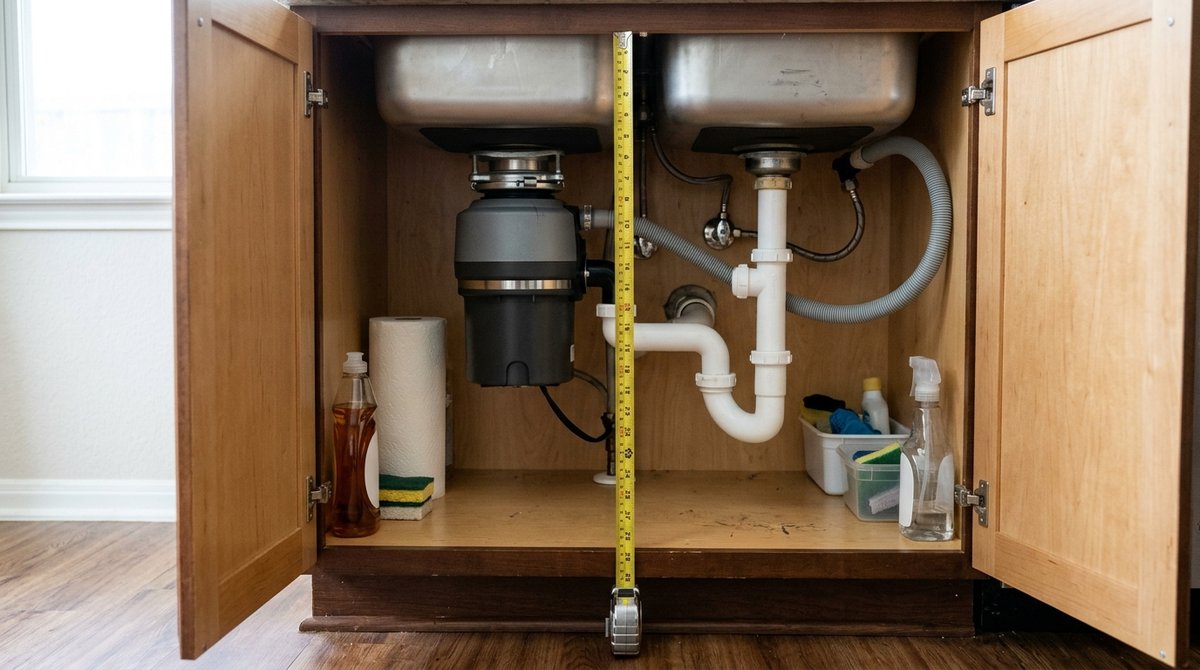
Horsepower: 1/3 hp to 1 hp
Horsepower is the main thing that separates one disposal from the next.
| Size | Best fit |
|---|---|
| 1/3 hp | Light use, one or two people, mostly soft scraps |
| 1/2 hp | Everyday use in a small to average household |
| 3/4 hp | Families who cook most nights |
| 1 hp | Heavy cooks, big households, tougher scraps |
More power grinds finer and jams less, but a bigger motor makes a taller unit. Measure the space under your sink before you buy. A tall unit can sit too low for the drain to slope the right way. If you are not sure, ask us first. We will tell you what fits without pushing the priciest model.
Continuous feed vs batch feed
- Continuous feed runs while the wall switch is on, and you feed scraps in as it grinds. It is the most common type and the easiest to use while cooking.
- Batch feed only runs when you put the stopper lid in place. There is no wall switch. It is a good choice if you have small children, or if adding a wall switch would mean opening up a finished wall. It is slower for big loads because you grind one batch at a time.
Sound insulation
Lower priced units are louder. Better models wrap the grinding chamber in insulation and use cushioned mounts, so the sink does not ring. In an open kitchen, you will notice the difference. Stainless steel grinding parts are also worth looking for, since they resist corrosion from our hard water.
If your home is on a septic system
A disposal adds solids to a septic tank. Heavy use means more frequent pumping. The University of Nebraska-Lincoln notes that professionals estimate a tank may need pumping twice as often as one in a household with light or no disposal use. If you are on septic, use the disposal sparingly, keep grease out of the sink, and talk to your septic professional about your pumping schedule. Some units are sold as septic models, but none of them remove the extra solids.
What a Professional Garbage Disposal Installation Includes
A disposal is only as good as the way it is mounted and connected. Many problems with a new unit come from the connections under the sink, not the disposal itself. Here is what our garbage disposal installation service covers.
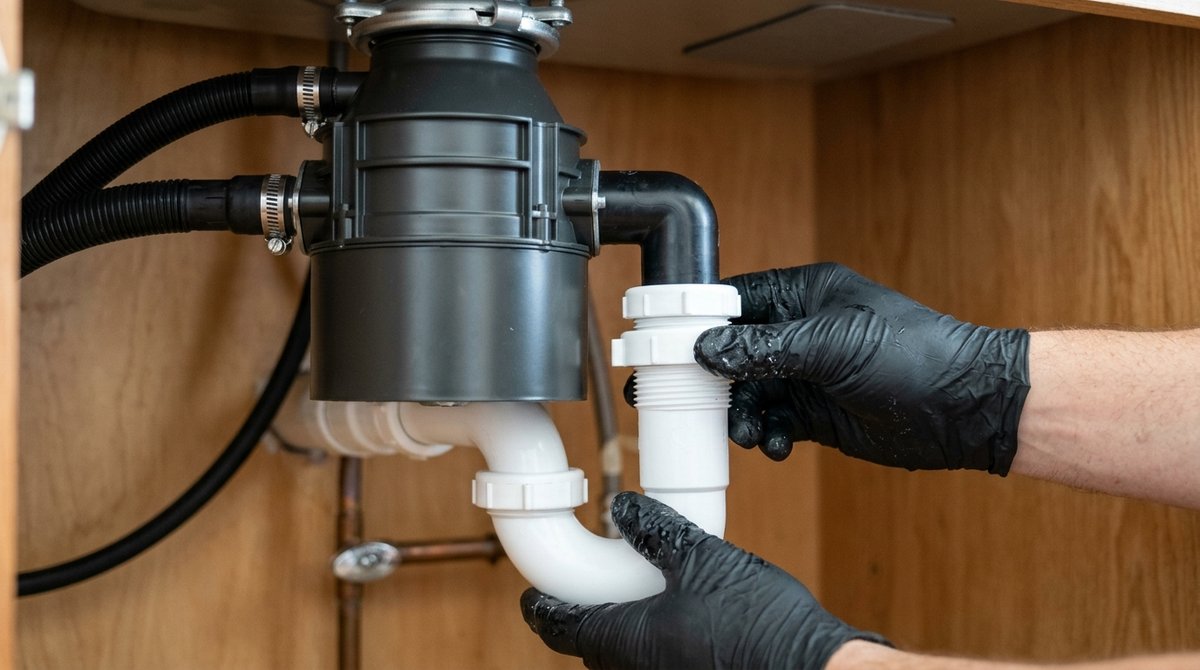
- A look at the sink setup first. I check the power, the drain and the dishwasher hose, then tell you what is needed and the price before any work starts.
- Removing the old unit. With the power off, the old disposal comes out and the old sink ring is removed. The sink opening gets cleaned so the new flange seals flat.
- Mounting the new unit tight. A loose mount leaks at the sink and rattles. If the new unit uses the same style of mount as the old one, the swap goes quicker.
- The drain connection and P-trap. The P-trap is the curved pipe below the sink that holds water to block sewer gas. Many older homes here still have thin metal traps and drain pieces. A new disposal sends more waste through them, so if the trap is metal, leaking or crusted inside, we replace it at the same time. The drain has to slope downhill so water does not sit in the line.
- The dishwasher knockout. New disposals have a small plug inside the dishwasher inlet. It has to be knocked out and removed before the hose goes on, or the dishwasher will not drain. It is an easy step to miss on a do it yourself install.
- The electrical connection. Some disposals plug into an outlet under the sink with a cord, which is often sold separately. Others are hardwired into a box. On a swap, we match what your old unit used. If there is no power under the sink at all, adding it is a job for an electrician, and we tell you that up front so both trades can be planned together.
- Running it and checking every joint. We run water and the disposal, then run the dishwasher, and look at each joint for drips before we leave.
A straight swap usually takes about one to two hours. You can buy your own unit and have us put it in, or ask what to buy first.
What Affects the Cost of a Disposal Replacement
We do not quote prices without seeing the sink. The things that move the number are whether it is a swap or a first install, the size of the unit, the condition of the trap and drain, and whether the dishwasher hose needs rerouting.
You get the price before the work starts. We back our workmanship with a warranty and pursue the manufacturer warranty on the disposal we install. Financing through Hearth is available if you are replacing more than one fixture at once.
Garbage Disposal Replacement FAQ
What size garbage disposal do I need?
For most households, a 1/2 hp or 3/4 hp unit handles everyday scraps well. Smaller homes with light use can get by with 1/3 hp. Heavy cooks and big families may want 1 hp. Check the space under the sink first, because larger units are taller.
Can I use a garbage disposal if my home is on septic?
Yes, but use it lightly. A disposal adds solids to the tank, which means more frequent pumping. Keep grease out of the sink, compost what you can, and ask your septic professional how often to pump.
Should I replace the disposal before Thanksgiving or wait until it fails?
If your disposal is already showing signs of failure, replacing it before the holiday saves you from a sink full of water on the busiest cooking day of the year. If it runs well, there is no need to replace it early.
Talk to a Master Plumber About Your Disposal
Not every disposal problem needs a new unit, and not every new unit needs the biggest motor. TD Plumbing Solutions helps homeowners across Benbrook and Greater Fort Worth make the right call, then does the work. A real person answers when you call. Contact us or book a garbage disposal replacement and installation visit, and I will tell you straight whether to repair or replace.