
Kitchen faucet replacement makes sense in Benbrook when repairs stop holding, the faucet body is cracked or corroded, or the finish is crusted beyond cleaning. If the faucet is sound and only a washer, O-ring or cartridge is worn, a repair is usually the better buy.
Repair or Replace Your Kitchen Faucet?
Most kitchen faucet trouble starts with one small part. A drip from the spout is usually a worn cartridge or seal. Water around the handle is often a tired O-ring. Those are quick fixes, and a good faucet can go years more after a fresh cartridge.
Don't leave a drip alone, though. The EPA notes that a faucet dripping at one drip per second can waste more than 3,000 gallons per year. That water is on your bill whether you notice it or not.
A repair is usually the right call when:
- The faucet is fairly new and replacement parts are easy to get.
- Only one thing is wrong, like a single drip or a loose handle.
- The body and finish are in good shape with no cracks or pitting.
Replacement starts to make more sense when:
- You have already repaired it and the drip came back.
- The body is cracked, or water seeps from the base no matter what you tighten.
- Parts are hard to find for an older or discontinued faucet.
- The finish is pitted or peeling and scale has worked into the seams.
- You are updating the kitchen, with a new sink or counter going in.
If you are not sure which side of that line you are on, our faucet repair service starts with finding the worn part. I show you what failed and tell you straight whether a repair will last or a new faucet is the better spend. I would rather lose a sale than push a replacement you don't need.
Why Hard Water Shortens Faucet Life in the Fort Worth Area
Water across Benbrook and Greater Fort Worth is hard. It carries a lot of dissolved calcium and magnesium, and those minerals leave scale everywhere water sits or dries. I covered the bigger picture in how hard water affects your plumbing in Benbrook. Here is what it means for a kitchen faucet in particular.
A kitchen faucet gets heavy use. Each time it shuts off, water dries at the aerator and base, and scale settles on the cartridge and seals inside. Over the years that leads to:
- Stiff handles that take more force to turn.
- Weak or uneven flow from a crusted aerator or spray head.
- Drips when scale keeps seals from closing all the way.
- Pitted finishes where mineral buildup has been scrubbed over and over.
You can't stop scale, but cleaning the aerator every few months and picking a faucet built for hard water both slow the damage.
How to Choose a Kitchen Faucet That Fits Your Sink
Before you look at styles, look at your sink and under it. Fit matters more than looks.
Hole count and deck plate
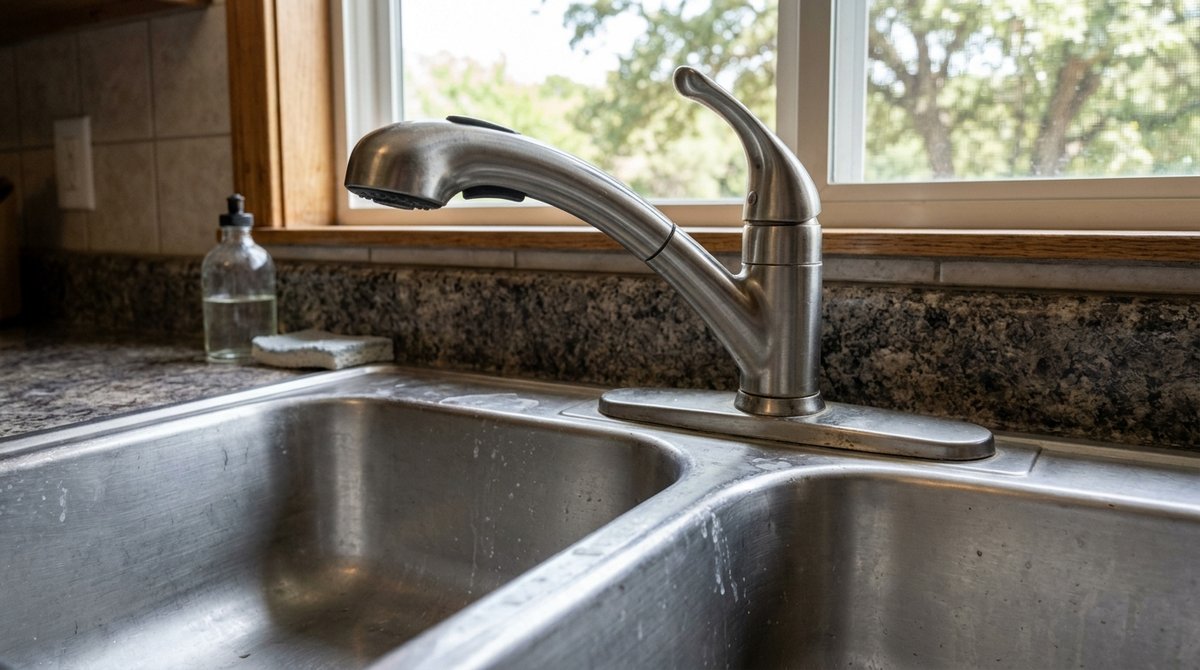
Count the holes in your sink or counter. Older sinks often have three or four holes for a two-handle faucet and a side sprayer. Many newer faucets need only one.
- Fewer holes than you have: A deck plate, the flat cover that sits under the faucet, can hide the extra holes. Check that the faucet comes with one or offers one.
- More holes than you have: You may need a new hole drilled. Whether that is possible depends on the sink and counter material.
Pull-down vs pull-out
Both have a spray head on a hose. A pull-down has a tall, arched spout and the head pulls straight down into the sink. It works well in deep sinks and makes filling pots easy. A pull-out has a shorter spout and the head pulls toward you. It suits smaller sinks and spots with low cabinets or a window above the sink.
Either style needs room under the sink for the hose and its weight to move freely. A garbage disposal or a crowded cabinet can get in the way.
Single vs two handle
A single-handle faucet lets you set temperature and flow with one hand, and it needs only one hole. A two-handle faucet gives finer control over hot and cold and suits a traditional look. With hard water, fewer moving parts generally means fewer places for scale to cause trouble.
Finish
Finish is about more than color. Some finishes show water spots and scale far more than others. Matte and brushed finishes tend to hide spotting better than high-shine ones in hard water.
Valve type: why ceramic cartridges hold up better
Look for a faucet with a ceramic disc cartridge. Two hard ceramic discs slide against each other to control the water, instead of a rubber washer pressing on a seat. Ceramic resists wear from scale and grit much better than rubber. It is not immune, and hard water can still stiffen it over time. But a ceramic cartridge usually goes much longer between repairs in water like ours.
Buying the faucet yourself is fine. Many homeowners do, and we install it. Keep the box handy so the parts and hole count can be checked before the old one comes out.
What a Professional Kitchen Faucet Install Includes
A new faucet only works as well as the valves and hoses behind it. That is the part people skip when they do it themselves, and it is where a lot of under-sink leaks start.
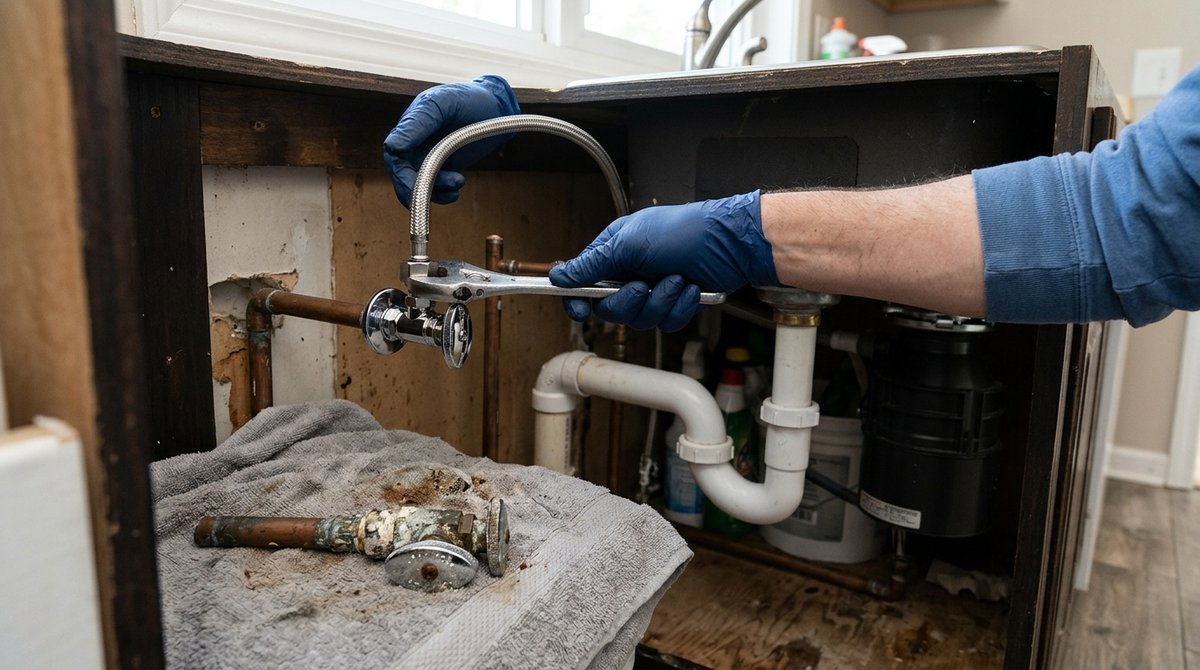
When I do a kitchen faucet installation, the job looks like this:
- Look and price it. I check the sink, the shutoff valves and the supply hoses, then give you the price before any work starts.
- Shut off and remove. The valves get closed, the old faucet comes out and old putty and scale get cleaned off the sink.
- Replace what is worn. Old braided or rubber supply hoses get swapped for new ones. A shutoff valve that won't turn or that drips gets replaced too.
- Set and connect. The new faucet goes in square and tight, and the lines are flushed so loose scale doesn't clog the new aerator on day one.
- Test and walk through. I run hot and cold at full pressure and check under the sink for drips before I leave.
Seized shutoff valves are common in older homes
Shutoff valves sit closed-off and untouched for years. In hard water, scale builds up inside them until the handle won't move or the valve won't fully close. In older Benbrook and Fort Worth homes from the 1950s and 1960s, the original valves are often well past due.
A stuck valve makes any faucet swap harder. Forcing it can snap the stem or start a leak at the packing nut. Replacing it during the install means you can actually shut the water off the next time you need to. If your hoses or valves need work beyond the faucet, see our water supply line service.
Most kitchen faucet swaps take about one to two hours. They run longer when valves or hoses need replacing or the old faucet is crusted in place. We back our workmanship with a warranty and pursue the manufacturer warranty on the parts we install.
When to Call a Plumber Instead of Doing It Yourself
Plenty of handy homeowners can swap a faucet. It is worth calling a plumber when:
- The shutoff valves won't turn or don't fully stop the water.
- The supply lines are rigid copper or old galvanized instead of flexible hoses.
- The old faucet is rusted or scaled in place and the mounting nuts won't budge.
- You need a new hole drilled in the sink or counter.
- The new faucet is touchless and needs power under the sink.
- There is water damage in the cabinet floor that needs a closer look.
FAQ
How long does a kitchen faucet last in hard water?
It varies with the faucet's quality, how much it is used and how often the aerator and finish are cleaned. Hard water shortens the life of seals, cartridges and finishes. A faucet with a ceramic cartridge and regular cleaning usually lasts longer than one with rubber washers.
Should I replace the supply lines when I replace my kitchen faucet?
Usually, yes. Many new faucets come with their own lines, and the old hoses to the shutoff valves may be worn. Braided hoses that are kinked, rusty or bulging should go. It costs far less now than a burst hose under the sink later.
Can you install a faucet I bought myself?
Yes. Keep the box so the parts and hole count can be checked first. If it won't fit your sink, you will hear that before any work starts.
Need a Kitchen Faucet Replaced in Benbrook?
A good kitchen faucet replacement comes down to picking one that fits your sink and handles hard water, then setting it on valves and hoses you can trust. I install and repair kitchen faucets across Benbrook and Greater Fort Worth, with the price explained before work starts and financing through Hearth for bigger kitchen updates.
Call us or book your faucet installation and you will talk to a real person. It is the master plumber on the license who shows up to do the work.