
Replacing a sewer line means taking out the old pipe that carries everything from your house to the city sewer and laying a new line in its place, usually PVC, on a steady downhill slope with cleanouts for future access. In Benbrook and Fort Worth that is a permitted job: the line is dug, laid, tested and inspected before the trench is filled.
I am Terrill Dobbs, the master plumber on the license at TD Plumbing Solutions. Most of the sewer lines I replace around here are original pipe from the 1950s, 60s and 70s that has cracked, sagged or filled with roots. Here is how I decide whether a line needs replacing, what the job looks like from start to finish, and what moves the price.
When Is Replacement Better Than Another Repair?
A single broken joint or one root intrusion can often be fixed by digging up that one spot and replacing a short section. That is a sewer line repair, and when the rest of the pipe is in good shape it is the right call.
Replacement starts to make more sense when:
- The line is broken in several places. Fixing one section of a line that is failing everywhere just moves the next backup a few feet down the pipe.
- You keep paying for the same problem. Roots that come back every year, or a backup every few months, usually mean the pipe itself has given up.
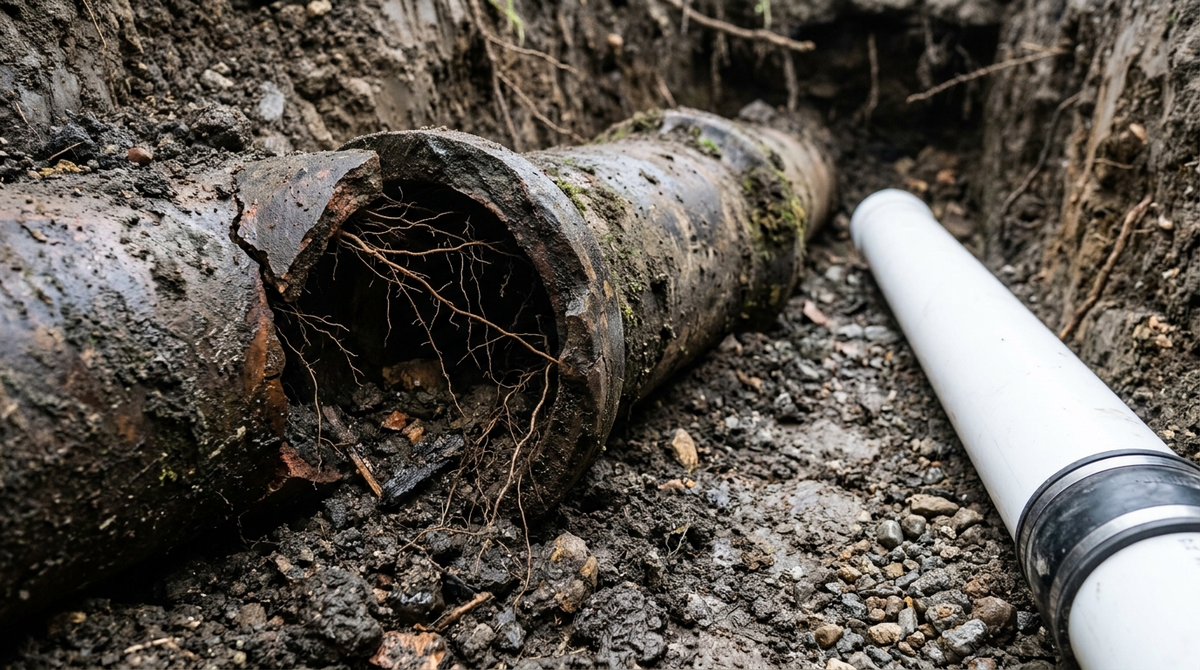
- The pipe is old cast iron, clay or fibre pipe. Cast iron rusts and scales from the inside. Clay pipe has joints every few feet that roots find easily. Fibre pipe, sometimes called Orangeburg, was used in some mid-century homes and flattens out over time.
- The line has a long sag. A belly is a low spot where waste sits instead of flowing. It can be cleared, but it fills right back up. The only real fix is relaying the pipe on the right slope.
- You are remodelling anyway. If a bathroom addition or kitchen move means tying new drains into an old line, it is often the time to replace the run.
Before I recommend replacing anything, I inspect the line so we both know where it is broken and how much of it is bad. If a repair will do, I will tell you that. You can read about the warning signs in how to tell your sewer line is failing.
What the Job Involves, Step by Step
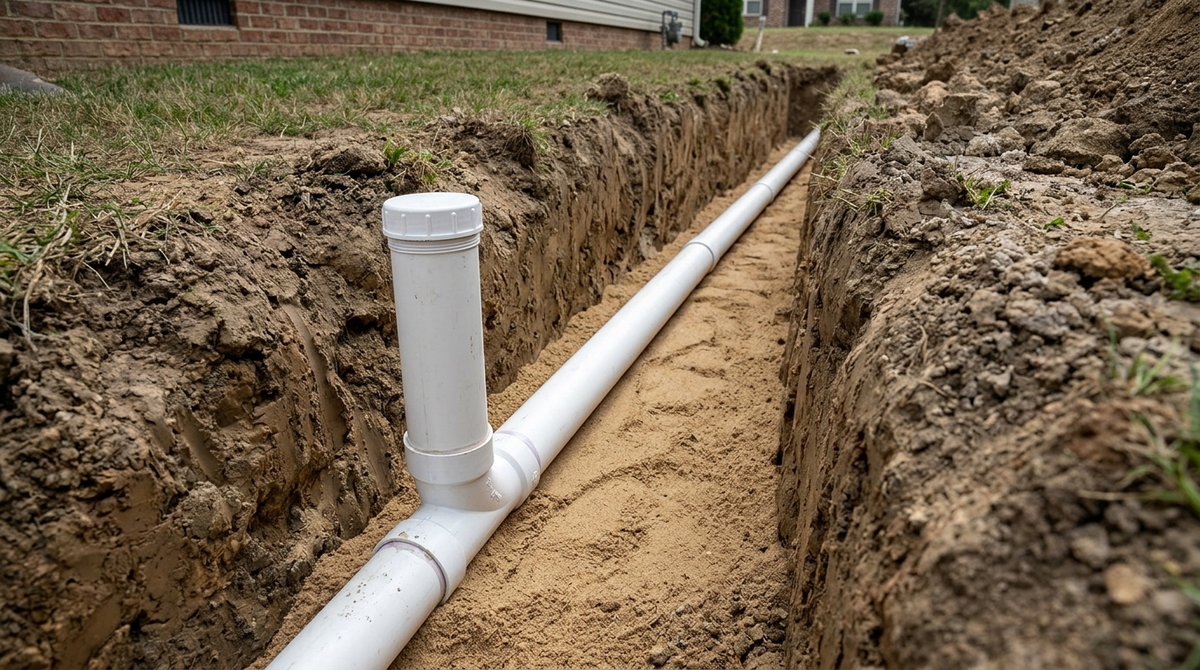
Every yard is different, but a sewer line replacement usually runs like this:
- Inspect and locate the line. I find where the line leaves the house, where it runs and how deep it sits, and confirm which sections are failing.
- Plan the route. Most of the time the new pipe follows the old one. Sometimes a better route avoids a tree, a driveway or a later addition built over the line.
- Permit and utility locates. I pull the plumbing permit with the city. Before any digging, the underground utilities get marked. The Railroad Commission of Texas says that homeowners, excavators and contractors are required by law to call 811 at least two days before digging, and the call is free. On my jobs, I make that call.
- Dig and remove the old pipe. The trench is opened from the house to the connection point, and the old pipe comes out or is abandoned in place where that is allowed.
- Lay the new line. New pipe goes on a firm, even bed so it keeps its slope as the soil settles. Getting the fall right is what keeps waste moving and stops a new belly from forming.
- Add cleanouts. A cleanout is a capped access point. With one near the house, a future clog can be cleared from outside without pulling a toilet.
- Test and inspect. The new line is tested for leaks, and the city inspector sees it before the trench is closed.
- Backfill and restore. The trench is filled and compacted in layers so the ground doesn't sink later, and the surface is put back.
Your water stays on for most of the job, but you can't use the drains while the old line is disconnected. I tell you ahead of time when that window will be so you can plan around it.
What Drives the Cost of Sewer Line Replacement?
I don't quote sewer lines over the phone, because two houses on the same street can need very different jobs. I price each one after I have seen the line, and you get that price before any digging starts. These are the things that move it most:
- Length of the run. A house set close to the street needs less pipe and less digging than one at the back of a deep lot.
- Depth. Deeper lines take more digging, more shoring and more time to backfill properly.
- What is in the way. Driveways, sidewalks, patios, fences and mature trees all change the plan. A large oak or pecan over the line may mean a different route.
- Pipe under the house. If the failing section runs under a slab, it has to be reached by cutting the floor or by tunnelling under the foundation. That is a bigger job, covered on the cast iron pipe replacement and tunnelling page.
- Where the line connects. Whether the new pipe ties in at a cleanout near the property line or further out changes how much has to be opened.
- Restoration. Replacing concrete or landscaping on top of the trench adds to the job.
Larger jobs like this can be financed through Hearth, so a failed sewer line doesn't have to wait.
Why Sewer Lines Fail Around Benbrook and Fort Worth
North Texas has a couple of things working against old sewer pipe.
Clay soil. Much of the ground here is expansive clay. It shrinks and cracks in a dry summer and swells after heavy rain. That movement pulls at pipe joints year after year, and old rigid pipe cracks or separates where it can't flex.
Thirsty tree roots. In a drought, roots go looking for water, and a cracked sewer joint is warm and wet. Once roots get in, they grow and catch everything that goes down the line. Clearing them helps for a while, but they come back through the same crack.
Age. Many neighbourhoods in Benbrook and the older parts of Fort Worth were built when cast iron and clay were standard. That pipe has done its job for fifty or sixty years, and plenty of it is reaching the end.
What Happens to Your Yard?
There will be a trench, and I won't pretend otherwise. What I can do is plan the route to avoid what matters most to you, keep the dig as tidy as the job allows, and backfill in layers so the trench doesn't sink into a ditch after the first rain. Grass comes back. If the line runs under concrete, we talk about that before the job starts so there are no surprises.
Sewer Line Replacement FAQ
Who is responsible for the sewer line, me or the city?
In most cities around here, the homeowner is responsible for the line from the house out to where it connects with the city's system, and the city owns the main. Exactly where that handoff sits varies, and I confirm it with the city as part of the permit.
How long does a sewer line replacement take?
Most residential replacements take a few days from digging to backfill, depending on the length, the depth and when the city inspection can be scheduled. Lines that run under the house take longer.
Can you replace just part of the line?
Yes, if the rest of it is sound. If the inspection shows one bad section on otherwise good pipe, I will recommend replacing only that section.
Do I need to be home during the work?
Not the whole time, but you will need to know when the drains are out of service, and someone needs to be available to let me into the house where the line connects.
What pipe do you use?
New residential sewer lines are usually PVC, which has smooth walls and tight joints that roots have a hard time getting into. I tell you exactly what goes in before we start.
Talk to a Master Plumber Before You Dig
If your sewer line keeps backing up or you have been told it needs replacing, get a straight answer on how much of it is really bad. TD Plumbing Solutions handles sewer line replacement and new sewer line installation across Benbrook, Fort Worth, Burleson and the towns around them, and a real person answers the phone 24/7. Contact us or call (817) 229-9450, and I will inspect the line, explain what I find and give you the price before any digging starts.